Shells...
Bye Bye Fan Fair
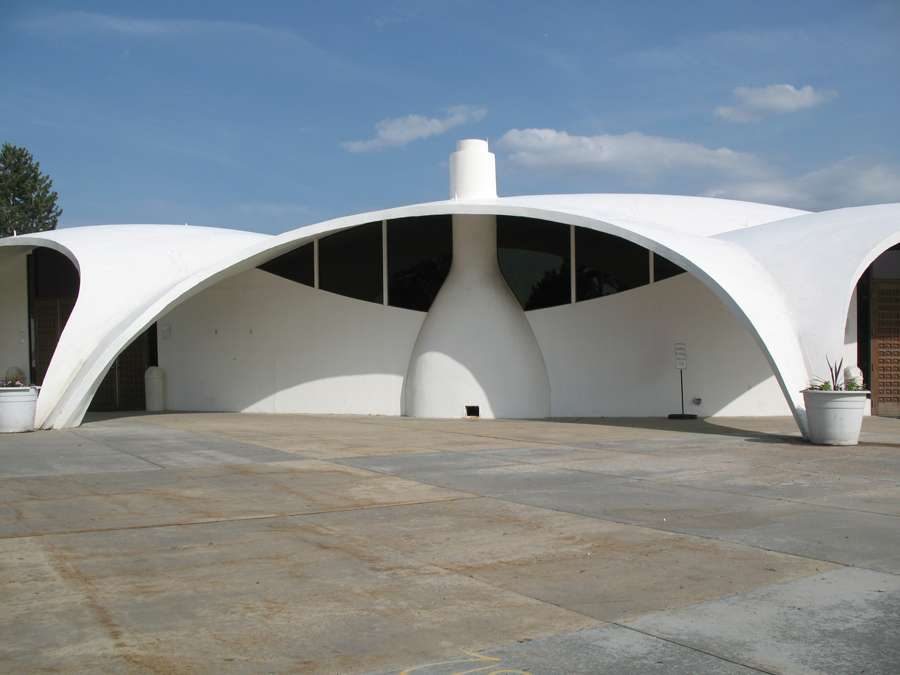
Aurora set to purchase, demolish blighted Fanfare building
Another Googie-style building coming down, this time Fan Fair Discount City, a department store from 1961 in Aurora.
This was a blighted area for 20 years, so this is far less of a loss than the Armet & Davis White Spot from the previous post.
I assume this will not be an easy tear-down due to asbestos and the strong thin-shell concrete construction of engineer Milo Ketchum, the same method used to create the hyperbolic parabaloids of the May D&F Plaza and the International Center at The Broadmoor or Hanger 61, the historic structure at old Stapleton.
November 21st, 2012 / No Comments » / by Tom Lundin
Aristrocrat detail
Detailed look at the concrete-shell roof and a suspended globe
lamp at the Aristrocrat on Colfax.
May 30th, 2012 / No Comments » / by Tom Lundin
Rainbo Bakery
The thin-shell concrete roofline of the Rainbo Bakery in Commerce City. I assume this building was constructed in the mid-1960s utilizing the talents of Denver thin-shell engineer Milo Ketchum.
January 31st, 2012 / 1 Comment » / by Tom Lundin
The Modern Architecture of Sleeper

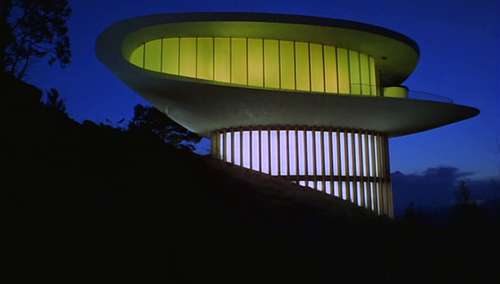
Charles Deaton’s Sculptered House of Genesee
Woody Allen chose Colorado in 1973 to film his famous science-fiction comedy, Sleeper,
because of the abundance of futuristic modern architecture along the front range to
feature as backdrops in his film. Here is a rundown of locations in order of appearance
in the movie.
This house at the beginning of the film is actually the back of the Church of the Risen Christ, designed 1969 by James Sudler.
Next, this shot is the Boettcher Memorial Conservatory designed 1966 by Victor
Hornbein and Ed White, Jr. at the Denver Botanic Gardens. The movie has a little
model futuristic car riding on a track in front.
Some locations I could not identify such as this interesting interior above. I am hoping
readers can write in and enlighten us.
These underground parking shots are another unknown. One reader suggests these are
from Cinderella City, but I can’t find shots of this to verify. Anyone?
The amazing Sculptured House of Genesee, built by Charles Deaton in 1966 and not
actually lived in until John Huggins completed it after purchasing the home in 1999.
After watching the film, it is clear that the circular elevator is not used as the famous,
ahem, Orgasmatron in the film as rumored, it is really just a cheap small prop.
This odd, yet beautiful building is the Varner House, designed 1969 by James Ream.
Another interesting concrete shell structure, I am hoping someone can write in and tell
me where it is.
Next we are off to Boulder to see Charles Haertling’s impressive Brenton House,
a 1969 design that resembles barnacles or possibly mushrooms.
More shot’s of Deaton’s Sculptured House. Charles Deaton also designed this similar
bank on South Broadway.
No visit to Boulder is complete without a visit to the I. M. Pei masterpiece, the National
Center for Atmospheric Research, N.C.A.R. (more shots of this coming up)
Of the locations in the film that I could not identify, this is the one I would really like to
track down. Anyone? I am guessing it is a church. Note: Reader Eric identified this as
Culver City High School in California. It is still there!
This is the Mile Hi Church in Lakewood with a McDonalds sign over the eye. It is now
accompanied by two other larger structures, the newest one is an enormous concrete shell.
N.C.A.R. in Boulder, one of the most beautifully sited structures ever. Of all the I. M. Pei
projects in Colorado, this is the one that has remained the most-intact. Planning started
in 1961, the building was completed in 1967.
And, finally, the late, great Currigan Exhibition Hall, designed by Jim Ream in 1969
for William Muchow Associates. It was built with the world’s largest use of the space
frame. It was torn down in 2002 to make room for the expansion of the Denver
Convention Center.
(Brutalist structures are the most under-appreciated, most misunderstood and most
endangered modern architecture.)
June 24th, 2011 / 9 Comments » / by Tom Lundin
Denver Coliseum
Photo © 2011 Scott Murdock
Completed 1952, the Denver Coliseum was designed by the Father of Thin-Shell
Construction, Anton Tedesko. It incorporated concrete thin-shell techniques perfected
by Tadesko while building airplane hangers for the U.S. Air Force.
(Note from editor: photo from new contributor Scott Murdock, photographer and
editor of the outstanding website http://www.airforcebase.net/)
June 21st, 2011 / No Comments » / by Scott Murdock
Court House Square

Photo © 2011 Alan Golin Gass, FAIA
Looking at I. M. Pei & Associates’ Court House Square from Mile High Tower
(another I. M. Pei & Associates building). Photo taken 1959.
Construction fences still surround the site and the Hilton Hotel has not yet been completed.
You can see the May D & F building with it’s original aluminum panels, the hyperbolic
parabaloid and the skating rink.
The tall building to the right is the original Republic Building, designed 1927 by
G. Meredith Musick.
June 10th, 2011 / No Comments » / by Alan G. Gass
Hilton Hotel window

Photo © 2011 Alan Golin Gass, FAIA
Looking out of the Mo-Sai grillwork of the Hilton Hotel window at the hyperbolic
paraboloid and May D & F building of Court House Square.
Court House Square designed by I. M. Pei & Associates, completed 1960.
(Note from the editor: This is the first, of hopefully many photos to be posted on
the Denver Eye by esteemed architect and photographer, Alan G. Gass, FAIA)
June 6th, 2011 / 2 Comments » / by Alan G. Gass
Sculptured House of Genesee
A beautiful rendering of the Sculptured House of Genesee, or the “Flying Saucer House”
as it is referred to by passerby on I-70.
Designed 1963 by Charles Deaton, it was the focal point of Woody Allen’s futurist comedy Sleeper from 1973. It was never quite finished until Denver’s John Huggins completed it and added the Deaton-designed addition in 2003.
October 11th, 2010 / 1 Comment » / by Tom Lundin
Wonder Bread Bakery
White fluffy clouds hover over the precast concrete-barrel shells of Wonder Bread Bakery.
I assume this was built in the early-1960s with the involvement of Denver’s master concrete-
shell engineer Milo Ketchum.
Here is a view of the east side on a clear day. Thank you Wonder Bread, for making
I-25 smell good at times!
(click on photo to enlarge)
September 22nd, 2010 / 3 Comments » / by Tom Lundin