Googie...
Garth’s Drive-In
Garth’s Drive-In, in Colorado Springs, circa-1950s, one of the early suppliers of
Kentucky Fried Chicken before KFC opened their own restaurants. The Googie-style
signage of this restaurant is just like the more-famous Norm’s in Los Angeles.
March 16th, 2013 / No Comments » / by Tom Lundin
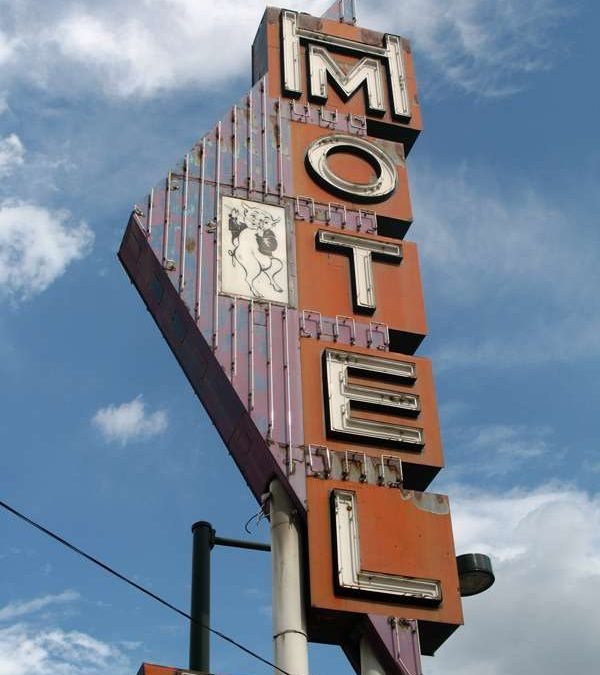
DeVille Motel
The DeVille Motel on Colfax at Galapago. First the original architectural illustration…
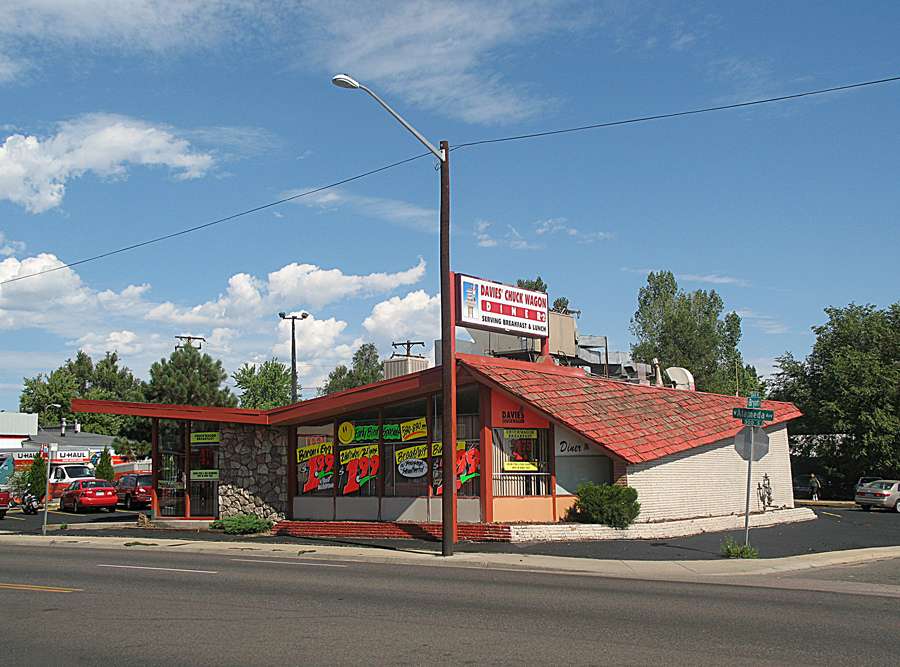
Then the final result, with a different design for the sign. This is now just an empty shell
between the Denver Diner and the new courthouse, destined to be torn down soon, I am sure.
February 23rd, 2013 / 1 Comment » / by Tom Lundin
Looker’s Derby
Looker’s Derby in Idaho Springs, started 1946 by Jim and his wife Johnnie Lucille
Looker. Later known as King’s Derby, I believe this place closed last year.
February 23rd, 2013 / No Comments » / by Tom Lundin
Bye Bye Fan Fair
Aurora set to purchase, demolish blighted Fanfare building
Another Googie-style building coming down, this time Fan Fair Discount City, a department store from 1961 in Aurora.
This was a blighted area for 20 years, so this is far less of a loss than the Armet & Davis White Spot from the previous post.
I assume this will not be an easy tear-down due to asbestos and the strong thin-shell concrete construction of engineer Milo Ketchum, the same method used to create the hyperbolic parabaloids of the May D&F Plaza and the International Center at The Broadmoor or Hanger 61, the historic structure at old Stapleton.
November 21st, 2012 / No Comments » / by Tom Lundin
Denver losing an Armet & Davis
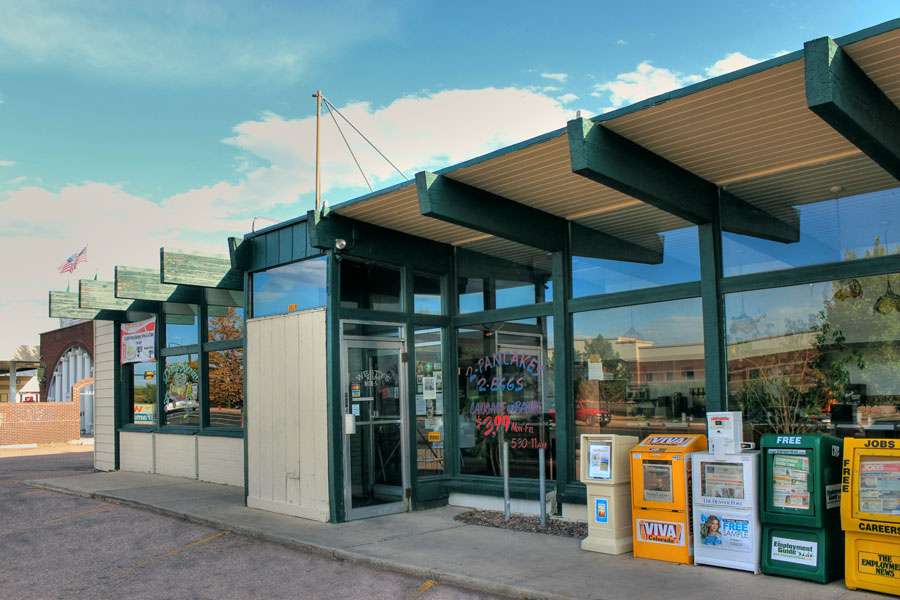
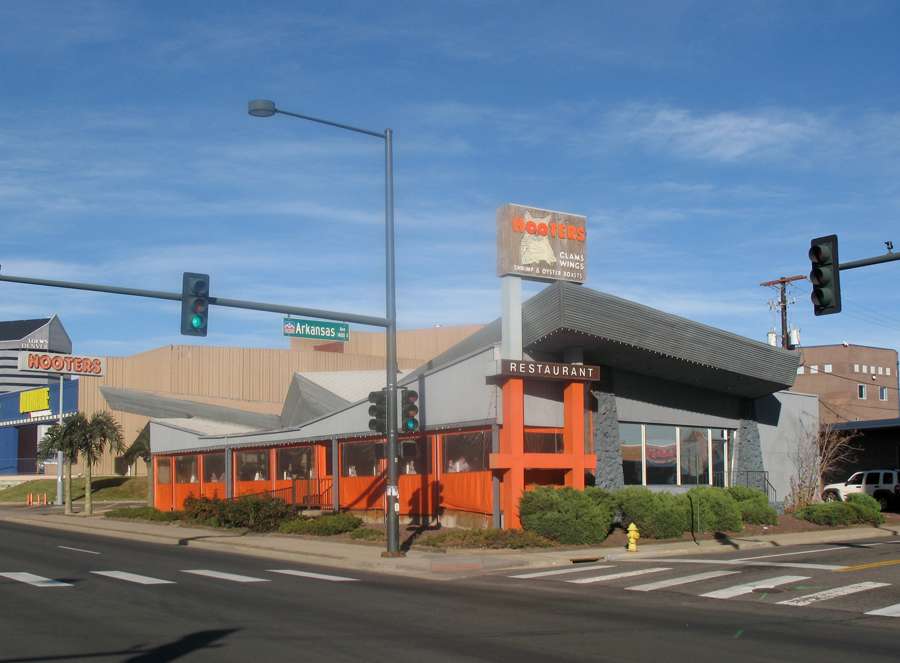
I am sure you probably noticed this while driving down S. Colorado, but they are getting ready to tear down one of Denver’s few remaining White Spot Googie-style coffee shop buildings.
This had been a Hooters for the last 23 years, but was originally a 1961 Armet & Davis design for Denver’s classic diner chain, White Spot. Hooters added a covered front porch, but kept the classic roof style, though altered a bit. The original signage would have pierced the roof in a similar way to the Hooters sign.
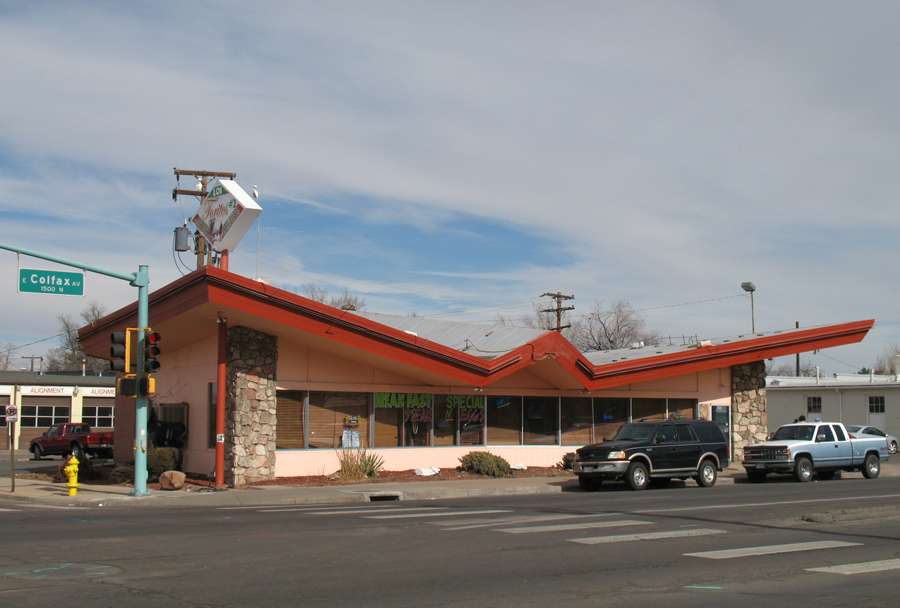
That will leave this building on E. Colfax as the last example of the classic “W” roofline formerly sported by some of the White Spots. The designers of these structures, Los Angeles firm Armet & Davis, designed most of L.A.’s most famous and iconic coffee shops of the ’50s & ’60s.
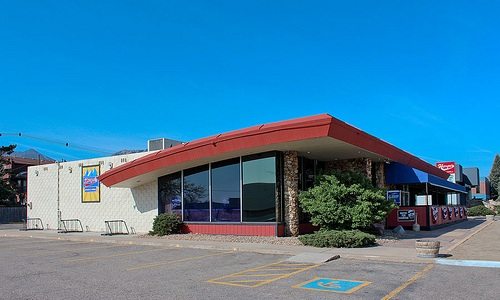
Armet & Davis designed other styles for White Spot besides the “W”. This former White Spot above with it’s tri-fold roof is a remarkable design and is currently unoccupied on W. Alameda. Tom’s Diner and The Denver Diner on Colfax are the two most prominent of the surviving White Spot Armet & Davis designs.
Azar’s Big Boy restaurants also used the Armet & Davis firm to design some of their restaurants. This location in Boulder has a beautiful arching roofline.
November 19th, 2012 / No Comments » / by Tom Lundin
Satellite sign
The last of this set of drawings, another SketchUp illustration, this one is the Satellite sign at Lakeside.
Now back to more photos!
June 22nd, 2012 / No Comments » / by Tom Lundin
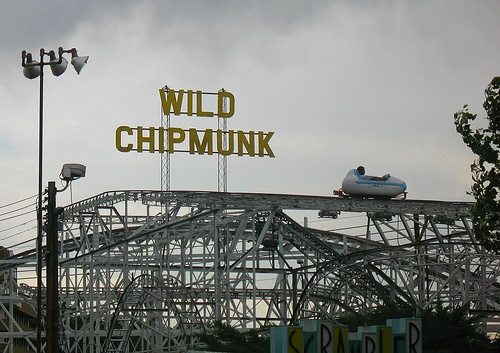
Wild Chipmunk sign
SketchUp illustration of the Wild Chipmunk sign at Lakeside.
June 15th, 2012 / No Comments » / by Tom Lundin
500th post! Lakeside extravanganza!
This is the 500th post to The Denver Eye!
Tom Lundin here, Eyeballer #1. I first took up architectural photography in 2006 to
supply myself with source material for my technical illustration habit. Photography quickly
became an obsession.
To celebrate I am posting these Lakeside Amusement Park shots from that year, 2006. Lakeside doesn’t always allow you to photograph freely, but these were all taken before that became an issue. All I had in those days was a point-and-shoot-camera with all the distortion and poor shadows that come with a smaller digital sensor and static lens. And on that day I dealt with weather that I could not control. But the subject matter stands out no matter what the circumstance!
Lakeside Amusement Park started as a White City in 1908. White Citys sprung up in various places across the United States as imitations of the White City set up at the World’s Columbian Exposition of 1893 in Chicago. There, they built a Beaux-Arts style city with hundreds of thousands of light bulbs provided with electricity by the competing technologies of Thomas Edison (direct-current) and Nikola Tesla (alternating-current).
The Tower of Jewels above is decorated with 16,000 light bulbs.
Lakeside is one of the oldest remaining amusement parks in the U.S. After Benjamin Krasner bought the park in the 1930s, he gave it an incredible Art Deco makeover with the aid of architect Richard Crowther.
When Richard Crowther moved to Denver, he was an expert at neon lighting as he had just lit up the San Francisco Golden Gate International Exposition Fair of 1940. Crowther became a famous Denver modernist architect, designing the Neufeld House in 1956. He designed multiple Cinerama theaters including Denver’s Cooper Theater on Colorado Blvd (now gone), and achieved his greatest fame as a pioneering green architect in Cherry Creek, noted for his use of Passive Solar Heating.
The Cooper Cinerama Theatre, from 1961.
Lakeside is filled withoutstanding examples of Art Moderne or Streamline Modern signs, ticket booths, gardens and other features. The parts of the park that are not Art Deco are from the original White City and are often reused elsewhere in the park.
The Starride ferris wheel from the earlier days of the park.
A minature diesel version of the Zephyr!
When this tower was built in 1908, it was the tallest structure in the state!
Looking out over Lake Rhoda.
Lakeside Speedway closed in 1988 after 50 years of racing!
Lakeside’s famous Merry-Go-Round. Four rows filled with the widest variety of animals you will ever see on any merry-go-round.
White City’s Casino Theatre
This steam-powered minature locomotive has been running here continously since the opening of the park in 1908!
6
June 5th, 2012 / 7 Comments » / by Tom Lundin
Aristrocrat detail
Detailed look at the concrete-shell roof and a suspended globe
lamp at the Aristrocrat on Colfax.
May 30th, 2012 / No Comments » / by Tom Lundin